Therapy and Islam: Is It Okay to See a Counsellor?
- Is therapy haram? A clear answer
- What the tradition actually says
- Faith and therapy are not rivals
- Counselling that respects your beliefs
- The worries beneath the question
- Common worries: backbiting, weak iman and medication
- Faith can be part of the healing
- Finding care that respects your beliefs
- When to reach out
- Frequently asked questions

For many practising Muslims in Bangladesh, one worry sits quietly behind the decision to try therapy or see a counsellor: is therapy against Islam and my faith? Should I not just pray harder, make more dua, and trust that Allah will ease it? It is a sincere question, and it deserves a sincere answer rather than a dismissal. The short version is that mainstream Islamic scholarship does not treat seeking mental-health care as a lack of faith. It treats it as caring for something Allah entrusted to you.
Is therapy haram? A clear answer
No. In mainstream Islamic scholarship, seeking treatment for illness is permitted and encouraged, and mental health care is a form of treatment. The Prophet (peace be upon him) said that Allah has not sent down any disease without also sending down its cure (Sahih al-Bukhari). Speaking to a qualified psychologist is one way of seeking that cure, just as seeing a doctor is for the body. If you still feel unsure, it is completely reasonable to talk it through with a scholar you trust alongside getting help.
What many scholars and Muslim clinicians say: getting help for your mind is part of looking after a trust, not a sign of weak faith. Psychiatrists writing in the Indian Journal of Psychiatry describe how Islamic beliefs can be built into psychotherapy so that Muslim patients receive care that is ethical, acceptable and effective for them (Sabry and Vohra, 2013). And a 2026 analysis of three clinical trials found that a faith-adapted talking therapy for Muslims with depression reduced symptoms more than standard CBT, with patients saying their religious identity mattered to their recovery (Mir et al., 2026). Therapy, in other words, can work with your faith rather than around it.
What the tradition actually says
Islam encourages seeking treatment. A well-known hadith records the Prophet Muhammad (peace be upon him) telling his companions, “Seek treatment, O servants of Allah, for Allah has not created a disease without also creating its cure.” Scholars often point to this precisely to answer the idea that getting help shows weak trust in God. The body and mind are described as an amanah, a trust, and looking after them is part of one’s duty, not a rejection of it. Seeking knowledge and seeking a cure are both encouraged. On this reading, going to a psychologist sits alongside going to a doctor for any other ailment, not against faith but consistent with it.
Faith and therapy are not rivals
You do not have to choose between your deen and your mental health. Prayer, dua and community are a genuine source of strength for millions, and good therapy does not ask you to give any of that up. In fact the two often work best together: faith gives meaning and steadiness, while a psychologist gives practical tools for the mind, the way a doctor gives medicine for the body. Making dua for recovery and also seeing a professional is not a contradiction. It is doing your part and trusting Allah with the rest, which is the very balance the tradition teaches.
Counselling that respects your beliefs
A good therapist works within your values, not against them. At Chum Wellness you can ask to be matched with a psychologist who understands and respects your faith, so your beliefs are treated as part of who you are rather than something to be argued with. Sessions are strictly confidential, available in Bangla or English, online or in person. Nothing in the process asks you to weaken your religion; the goal is simply to help you feel and function better. You can start with individual counselling or book a session, and browse our certified psychologists first if you prefer.
The worries beneath the question
When people ask whether therapy fits with Islam, there are usually specific fears underneath. Will the therapist tell me my religion is the problem? Will I be pushed toward a secular way of life? Will I have to expose things that feel private before Allah? These are fair concerns, and the answer to each is reassuring. A professional psychologist is not there to argue you out of your faith; they are there to help you feel and function better within the life and values you already hold. Your beliefs are treated as part of your strength, not a symptom.
Common worries: backbiting, weak iman and medication
- “Isn’t talking about my family backbiting?” Many scholars distinguish between describing a problem in order to get help or advice and backbiting for its own sake. In therapy you mostly speak about your own feelings and experiences. If this worries you, ask a scholar you trust.
- “Does needing help mean my iman is weak?” No. Mental illness is not a measure of faith. Grief and sorrow are part of human life, and the Prophet himself went through a year remembered for its sorrow. Seeking help is an act of care for the body and mind Allah entrusted to you.
- “Is taking medication allowed?” Taking medicine prescribed by a qualified doctor is seeking a cure, and the same principle applies to mental health medication.
At Chum Wellness, psychologists work within your values rather than around them. Couples looking for faith-sensitive support may find our guide to Muslim couple counselling in Dhaka helpful.
Faith can be part of the healing
Far from being at odds with therapy, faith is often one of the most powerful resources a person brings into it. Prayer, gratitude, patience or sabr, community and a sense of meaning are protective for mental health, and a good therapist will work alongside them rather than against them. For many Bangladeshi Muslims, the most helpful path combines the steadiness that faith provides with the practical tools a psychologist teaches, each doing what it does best. You are not asked to choose between your Lord and your wellbeing; the two can pull in the same direction.
Finding care that respects your beliefs
If faith-sensitivity matters to you, say so when you book. You can ask to be matched with a psychologist who understands the religious and cultural context you live in, so you do not spend sessions explaining the basics of your world. What you will not get from a responsible service is anyone issuing religious rulings; for specific questions of what is permissible, a knowledgeable and trusted scholar is the right person to ask. The psychologist’s role is the mind, the scholar’s role is the ruling, and there is no conflict in seeking both.
When to reach out
If low mood, anxiety or distress has lasted more than two weeks and started affecting your worship, sleep, work or relationships, it is worth speaking to someone trained, alongside whatever spiritual practice steadies you. Recognising the signs you need to see a psychologist is a good place to start. Caring for your mind is part of caring for the trust Allah gave you.
In a crisis: if you or someone else is at risk of harm, call the national emergency service 999. Counselling is not a substitute for emergency care.
Frequently asked questions
Is going to therapy haram in Islam?
Mainstream Islamic scholarship broadly holds that seeking mental-health treatment is permissible and even encouraged, in line with the teaching to seek a cure for every illness. If you have specific concerns, a knowledgeable, trusted scholar can advise you on your situation.
Is therapy allowed in Islam?
Many scholars and Muslim clinicians say yes: seeking treatment is encouraged, and talking therapy is a form of treatment. Faith-sensitive therapy that respects your beliefs is widely practised, and research shows it can work well for Muslim clients. For a ruling on your own circumstances, ask a scholar you trust.
Is it haram to talk about my family or problems with a therapist?
Many scholars distinguish describing a problem to get help from backbiting for its own sake. In therapy you mainly talk about your own feelings and experiences, in strict confidence, with the aim of healing. If you are unsure, ask a scholar you trust.
Should I just pray instead of seeing a counsellor?
Faith and professional help are not either-or. Many people find that prayer and therapy support each other, the way dua and medical treatment do for a physical illness.
Can I have a therapist who respects my religious values?
Yes. Tell us when you book, and we will match you with a psychologist who works within your beliefs rather than against them.
Are sessions private?
Completely. What you discuss is confidential and never shared with family, community or anyone else.
Can a Muslim see a non-Muslim therapist?
Yes. What matters most is that the therapist is qualified, respects your beliefs and does not ask you to act against them. If you prefer a therapist who shares your faith, you can ask for that when you book.
Is being a therapist haram?
No. Helping people heal from distress is widely seen as valuable and honourable work, and many practising Muslim psychologists work in Bangladesh and around the world.
How this article was made
- Written by
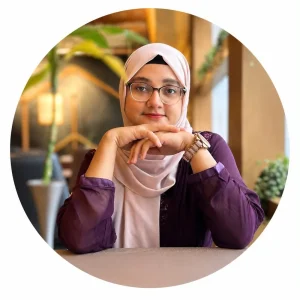
- Sharmin Akter Shetu, Senior Assistant Psychologist
- Clinical reviewer
- Samsun Nahar, Assistant Clinical Psychologist
- Last updated
- October 27, 2026
Every Chum article is written for people in Bangladesh by a Chum psychologist or our editorial team, and clinically reviewed by a certified psychologist or psychiatrist who specialises in its topic. How we review · Report an error
Where to go from here
Three next steps, from lightest to most support.

Keep Reading

Talk to our psychologists
Book a confidential session with a certified psychologist at Chum Wellness.