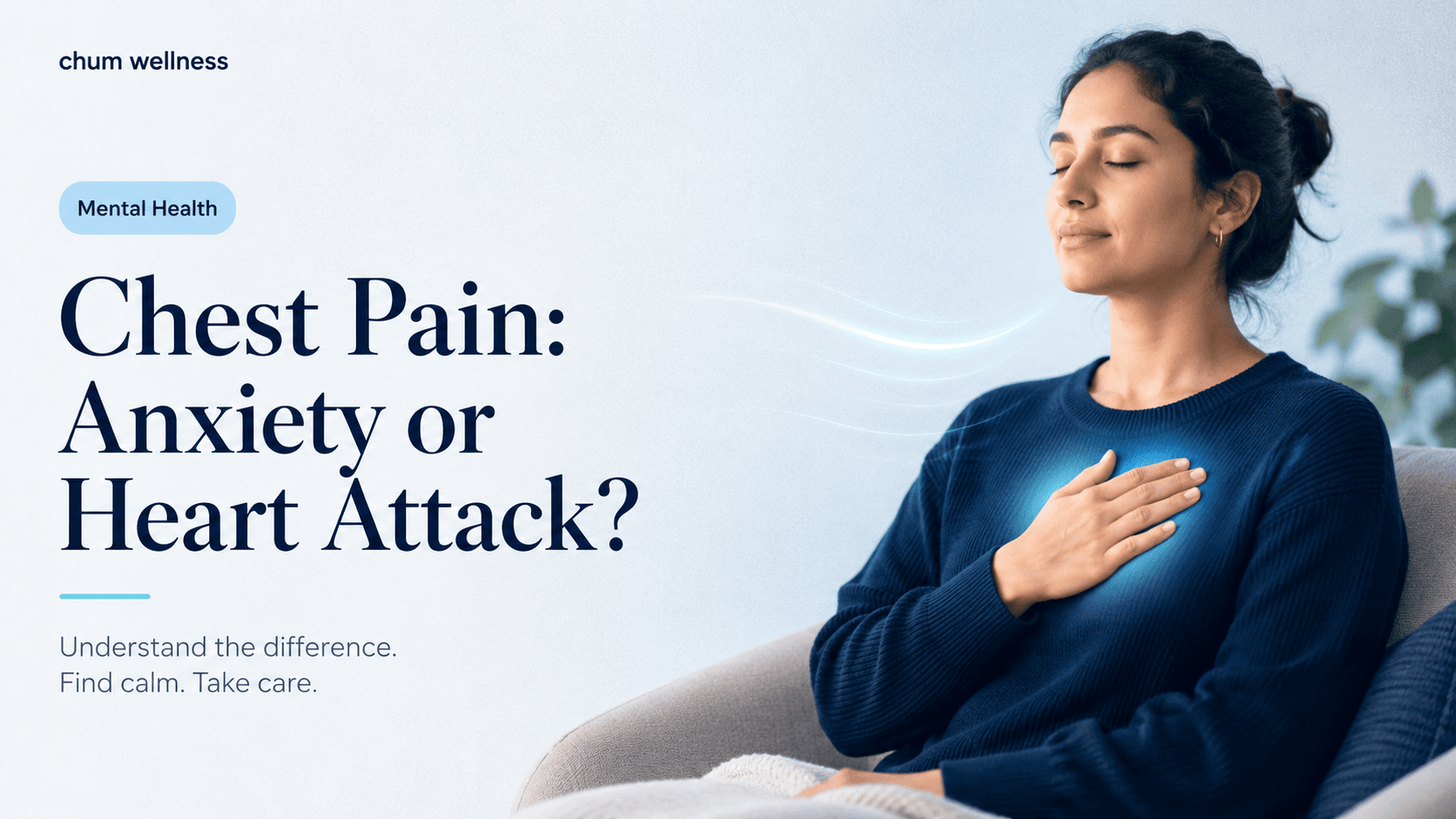
Chest Pain: Anxiety or Heart Attack? How to Tell the Difference

Your chest tightens. Your heart pounds. A sharp or heavy feeling spreads across your chest and a single terrifying thought takes over: Is this a heart attack? For millions of people, that frightening chest pain is not the heart at all, it is anxiety. But because the two can feel almost identical, knowing the difference matters enormously.
- This guide explains the topic in practical language, including common signs, causes, and next steps.
- If symptoms affect daily life, relationships, sleep, work, or study, speaking with a licensed psychologist can help.
- Chum Wellness offers confidential online and in-person support in Dhaka.
This guide explains why anxiety causes real, physical chest pain, how to tell anxiety chest pain apart from a heart problem, what to do in the moment, and when you must seek emergency care. It is educational information, not a medical diagnosis, if you are worried about your heart, always get checked by a doctor.
⚠️ When chest pain is an emergency, call for help now
Anxiety does cause chest pain, but you cannot diagnose a heart attack yourself. Treat it as an emergency and call your local emergency number or go to the nearest hospital if the pain:
- Feels like crushing pressure or a heavy weight on your chest
- Spreads to your arm, jaw, neck, back, or shoulder
- Comes with cold sweat, nausea, or shortness of breath
- Lasts more than a few minutes or keeps coming back
- Happens during physical exertion, or you have heart-disease risk factors
When in doubt, get it checked. It is always better to be examined and reassured than to wait.
Can anxiety really cause chest pain?
This overlap is well documented, not a quirk of your body. The National Institute of Mental Health describes panic attacks as producing pounding heart, chest pain, shortness of breath, sweating and dizziness, and notes that people experiencing one often believe they are having a heart attack or dying. Feeling certain it is your heart is a symptom of the condition, not evidence against the diagnosis.
That said, the certainty cuts both ways. Because the symptoms genuinely overlap, never diagnose yourself mid-episode. If this is new chest pain, or different from your usual pattern, get it checked medically first, then treat the anxiety.
Yes, and the pain is genuinely physical, not “in your head.” When you feel anxious or have a panic attack, your body floods with adrenaline and shifts into fight-or-flight mode. Several things happen at once: the muscles in your chest wall tense up, your breathing becomes fast and shallow, your heart rate climbs, and the tubes in your lungs tighten. Each of these can produce chest pain, tightness, or a stabbing sensation. Hyperventilation alone, breathing too fast, can cause chest discomfort, tingling, dizziness, and a feeling that you cannot get enough air.
That is why anxiety chest pain feels real: it is real. The cause is your nervous system, not blocked arteries.
Anxiety chest pain vs heart attack: how to tell the difference
There is no 100% reliable way to self-diagnose, which is why the red flags above always come first. That said, anxiety chest pain and cardiac chest pain often differ in character:
| Feature | More likely ANXIETY | More likely HEART problem |
|---|---|---|
| Type of pain | Sharp, stabbing, or fleeting; in one spot | Crushing pressure, squeezing, or heaviness |
| Location | Often centre-left chest, moves around | Centre of chest, may spread to arm/jaw/back |
| Trigger | Stress, worry, panic, no exertion | Often physical exertion or effort |
| Duration | Comes in waves; eases as panic fades | Persistent; builds and stays |
| Other symptoms | Racing thoughts, tingling, fear, fast shallow breathing | Cold sweat, nausea, severe breathlessness |
| What helps | Slows with calm, slow breathing | Does NOT ease with breathing or rest |
Notice the last row: anxiety chest pain often eases when you slow your breathing and the panic passes. Cardiac pain usually does not. But “usually” is not “always”, which is why an unexplained, severe, or new chest pain always deserves a check-up.
Why does anxiety chest pain happen on the left side?
Many people feel it on the left and immediately think “heart”. In reality, chest-wall muscle tension and the way we focus attention on the left (where we know the heart sits) make left-sided anxiety pain very common. The location alone does not tell you the cause.
How to relieve anxiety chest pain in the moment
Once you are confident it is anxiety (and not a medical emergency), these steps help break the panic cycle:
- Slow your breathing. Breathe in for 4 counts, hold for 4, out for 6. Longer out-breaths switch off the fight-or-flight response. Our guide to breathing exercises for stress walks through several techniques.
- Name what is happening. Telling yourself “this is anxiety, it will pass, it has passed before” reduces the fear that fuels the pain.
- Ground yourself. Notice five things you can see, four you can hear, three you can touch. This pulls attention away from the chest.
- Relax your shoulders and chest. Drop your shoulders, unclench your jaw, let the chest-wall muscles soften.
- Don’t fight it. Resisting panic makes it stronger. Let the wave rise and fall, it always falls.
Why it keeps happening: the panic cycle
Anxiety chest pain often becomes a loop. You feel a normal body sensation → you fear it is your heart → fear triggers adrenaline → adrenaline causes more chest tightness → that “proves” something is wrong → more fear. People with health anxiety can get trapped here for months, making repeated hospital visits that come back clear. Breaking the cycle usually needs more than reassurance, it needs to retrain how your brain interprets those sensations.
When to see a professional
First, see a doctor to rule out physical causes, that step is important and reassuring. Once your heart is cleared, recurring anxiety chest pain is very treatable. Cognitive Behavioural Therapy (CBT) is the gold-standard approach: it helps you reinterpret body sensations, reduce avoidance, and calm the panic cycle. Most people see real improvement within 8–12 sessions. If panic attacks or health anxiety are taking over your life, that is exactly the kind of thing therapy resolves.
Not sure where you stand? A quick, private anxiety self-check can help you gauge your symptoms before you reach out.
Ready to Take the First Step?
Chum Wellness has qualified therapists in Dhaka who specialise in exactly this. Book a session, a confidential space to talk, with no long-term commitment.
Frequently asked questions
Can anxiety cause chest pain for hours or days?
Anxiety chest pain usually comes in waves tied to stress or panic and eases as you calm down. Pain that is constant for hours or days should always be assessed by a doctor to rule out other causes.
How do I know it is anxiety and not my heart?
You cannot be certain on your own. Anxiety pain is often sharp, moves around, and eases with slow breathing, while cardiac pain is more often crushing pressure that spreads and does not ease. If in doubt, treat it as an emergency and get checked.
Is anxiety chest pain dangerous?
The pain itself is not harmful, but it is distressing and exhausting. The danger is assuming chest pain is anxiety when it is not, so get a medical check first, then treat the anxiety.
What treatment stops anxiety chest pain?
Once your heart is cleared, CBT is the most effective treatment. It retrains how your brain reads body sensations and breaks the panic cycle, usually within 8–12 sessions.
📊 Key Takeaways: Psychotherapy
- Evidence-Based: Therapies like CBT are globally recognized as highly effective for depression and anxiety.
- Root Causes: Therapy goes beyond symptom management to address the underlying causes of distress.
- Safe Space: A clinical psychologist provides complete confidentiality and non-judgmental professional support.
Ready for support? If anxiety is affecting your daily life, you don’t have to manage it alone. Chum Wellness offers anxiety therapy in Dhaka with licensed psychologists, online across Bangladesh or in person.
Keep Reading
Talk to our psychologists
Book a confidential session with a licensed psychologist at Chum Wellness.